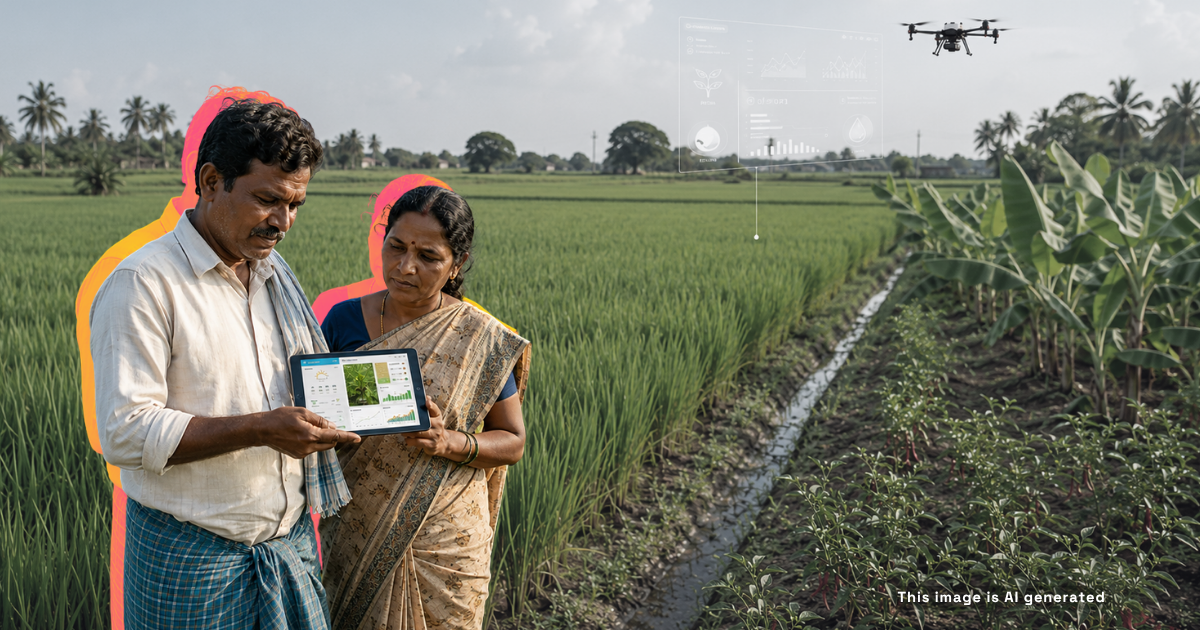
In a remote corner of Andhra Pradesh, where the road thins out into fields and the only structure in sight is a small Rythu Seva Kendra (RSK), a conversation was already underway. A few farmers had gathered. A team stood at the centre, discussing something that, at first glance, sounded technical — intercropping. The idea that the same piece of land could hold more than one crop. That oil palm, which many farmers in the region were now growing, did not have to stand alone.
At the edge of the group, one farmer listened quietly. He wasn’t part of the discussion. Not asking questions. Just observing. Then, almost abruptly, he pulled his chair forward.
“Madam,” he said, “what you’re saying is interesting.” He had two to three acres of oil palm, he explained. He had been thinking about expanding. But if there was a way to earn more from what he already had, he wanted to understand it. What followed was not a formal training session. It was a conversation. What if you plant cocoa alongside oil palm? What about vegetables? How do these combinations work? What would it mean for water, for soil, for income? The farmer leaned in, asking questions, weighing options, testing ideas aloud.
There was curiosity, but also calculation. This wasn’t experimentation for its own sake — it was a decision about livelihood. Fifteen minutes later, he had made up his mind. “I’ll try this in the next season,” he said. It was a small moment. Easy to miss if you weren’t paying attention. But it captured something that Andhra Pradesh is trying to build at scale — a system where the right information reaches the farmer at the right time, and turns into action. Not occasionally. Not by chance. But consistently. Across the state, agriculture is being reshaped not just through schemes, but through systems. Andhra Pradesh has placed farmer welfare at the centre of this effort, building an ecosystem that brings together frontline workers, digital tools, and a rapidly expanding pool of data.
At the heart of it are the Rythu Seva Kendras — spaces that are at once physical and functional, where policy meets practice. But what gives them strength is not the building itself. It is the people inside. Frontline workers — many of them women — move between farmers, fields, and forms every day. They help farmers plan crops, verify details on the ground, guide them through schemes, and increasingly, work through layers of digital systems that track and support these processes. In places closer to towns, this shift already feels embedded. Work that once took days is compressed into hours. Information travels faster. Farmers are more exposed to new practices — from drone-based spraying to alternative inputs — and are beginning to adopt them.
There is a certain ease here. Technology has found its place. But travel further out, and the system begins to feel different. The tools are still present. The apps exist. The processes are in place. And yet, something doesn’t quite connect. Because for technology to work here, it should go beyond existing. It should make sense. Which is why that 15-minute exchange begins to feel important again.
Because what happened there did not depend on a platform. It depended on clarity. On context. On someone being able to take a concept and translate it into something usable. To put it simply, what was explained by the team in those fifteen minutes, technology should be able to do. Not in a way that replaces people, but in a way that supports them. Today, that support still relies heavily on a human loop — on frontline workers who interpret, guide, and build trust. But as the system evolves, there is a growing sense that the next step lies in extending that loop.
This is where emerging technologies, particularly AI, begins to enter the conversation. Not as something abstract, but as a practical possibility. What if the farmer in that remote village did not have to wait for someone to explain intercropping options? What if that guidance could reach them directly, in a form they could understand, when they needed it? What if the system could reduce the need to repeat information, to navigate multiple platforms, to piece together fragmented data?
In a state that is already building one of the most extensive agricultural data ecosystems in the country by drawing from both large-scale and hyperlocal inputs, the potential is not difficult to imagine. And yet, what stands out is not just the ambition of the system, but its direction. Alongside digital expansion, Andhra Pradesh is also pushing forward community natural farming, helping farmers move away from chemical inputs and towards more sustainable practices. In some places, even this shift is intersecting with technology, with innovations like drone-based application of natural formulations beginning to take shape.
It is an unusual pairing at first glance. Technology and natural farming. Data systems and traditional practices. But on the ground, it feels less like a contradiction and more like a convergence. As if the question is no longer whether to choose between the two, but how to make them work together.That afternoon in the village did not end with a grand conclusion. The farmer stood up, the conversation moved on, and the day continued as it always does. But something had shifted.
A decision had been made. A possibility had taken root. Multiply that moment across thousands of villages, across millions of farmers, and you begin to see what Andhra Pradesh is attempting. Not just to introduce technology into agriculture. But to build a system where knowledge travels — across distance, across complexity, across gaps that have long defined how farming works. And where, eventually, a farmer does not have to wait for the right conversation to happen. Because the system brings it to them. What makes this effort particularly distinctive is not just the scale of the state’s ambition, but how deliberately it has been assembled.
This is not a single-organisation effort, nor a standalone technology intervention. It is a collaboration that brings together global institutions like the Gates Foundation, technology partners such as Vassar Labs, and AI advisory experts, implementation and field-focused organisations including Athena Infonomics and Catalyst Management Systems. Each contributes a different layer, from data and platforms to on-ground coordination. What emerges is not a collection of projects, but a system — one that is designed to hold together, and to reach the farmer more effectively because of it.
About the Author

Atreyee Kar is the Senior Manager of Marketing and Strategic Communications at Athena Infonomics. With experience across sectors including financial services, consulting, public health, and social impact, she focuses on shaping narratives, building digital presence, and documenting impact.
Outside work, she enjoys blogging, photography, and exploring food, and is passionate about using communication to drive positive social change.
.png)