AI has quickly become part of everyday work for many teams. It helps with first drafts, edits, ideas, summaries, and the small tasks that make the day move faster.
But what happens when a team tries to use AI for more complex work — the kind that involves business development, proposal quality, partner research, pipeline tracking, and institutional memory?
For Athena’s Central Business Development (CBD) team, the answer did not come from one big tool or one perfect prompt. It came from trial, error, frustration, better models, repeated experiments, and a gradual shift in how the team approached everyday work.
In this conversation, Shivi Rawat, Associate Director of the CBD team, reflects on how the team made that shift.
Shivi: In the initial stages, the team struggled quite a bit — particularly with early AI tools. Outputs were often fragmented, inconsistent, and needed significant review, editing, and factchecking before they could be used. That created a real disincentive for adoption. Team members spent considerable time correcting AI-generated content, and the return on effort wasn't obvious. Instead of saving time, AI often felt like it was creating more work.
The turning point came with newer-generation models, particularly Claude. Output quality, reasoning, consistency, and presentation improved sharply. As trust grew, so did adoption across the team.
More importantly, our relationship with AI has evolved. We started by using it to complete individual tasks. Today CBD team increasingly treats it as a collaborative partner — delegating substantial pieces of work, brainstorming solutions, refining ideas, and tackling problems we might not have approached on our own. That shift, from assistant to collaborator, is when we began realizing the real value: not just doing existing work faster but expanding what the CBD team could take on and solving problems in entirely new ways.
The first real win was the CBD Onboarding Portal — a single point of reference built to help anyone joining the team get up to speed on all CBD resources. Once we saw it being used, there was no looking back. We started looking at every workflow and every BD process through a new lens. Could we track wins the same way? Could we compare partner options with the same rigor? Each question became a new asset.
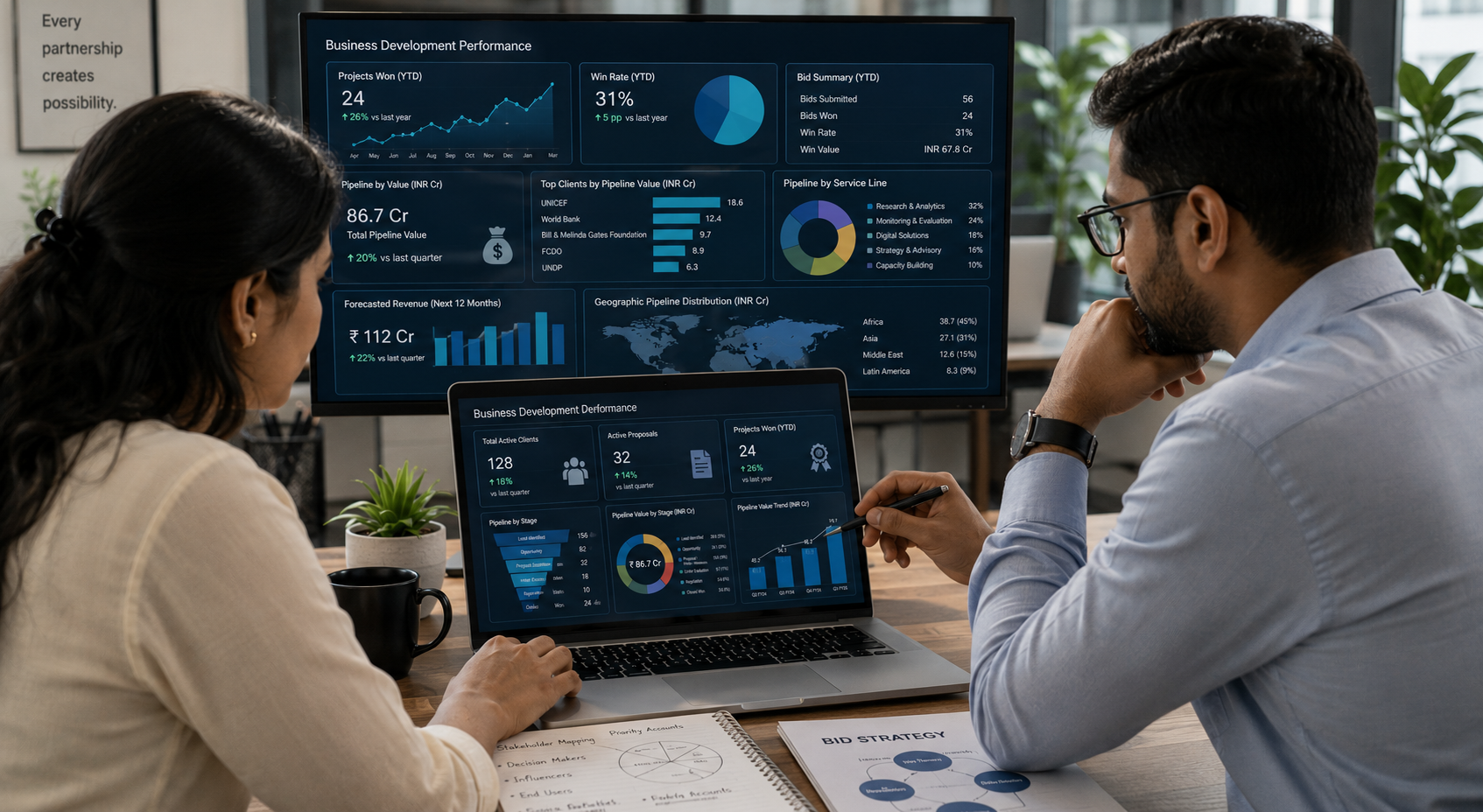
Today the CBD team runs on a stack of AI-enabled tools: the CBD Onboarding Portal, a Wins Tracker and pipeline dashboards for portfolio intelligence, structured pre-submission review workflows for proposal QA, and a library of 30+ reusable skills covering funder mapping, partner assessment, capability statements, and competitor intelligence.
Internally, we frame this progression through our LEAP model — Leverage, Embed, Automate, Productize. Most tools started as a one-off prompt (Leverage) and matured into a standing asset anyone on the team can run (Productize).
Shivi: Since 2024, we've deliberately experimented across different AI platforms rather than betting on one. We started with ChatGPT, moved to Microsoft Copilot, and since March this year have been working extensively with Claude.
Two principles have guided this journey. First, platform independence. We don't want to depend on a single AI vendor. Whenever we build an asset, workflow, or agent, we try to make it platform-agnostic — using Copilot where it excels, ChatGPT where it's stronger, and replicating our legacy agents and assets in Claude so nothing is locked into one platform. That gives us flexibility as the landscape shifts under us.
Second, we've focused on continuously cross-validating AI prompts, skills, and workflows across different AI platforms. Rather than assuming one tool is best for everything, we constantly test what works best for different tasks and behaviors, while also understanding the strengths and limitations of each model. This allows us to make evidence-based decisions about which tool is best suited for a particular use case, instead of defaulting to a single platform.
We also spend considerable time understanding the workflow implications of AI. Rather than expecting one model to perform every task, we look at how different stages of a workflow can be delegated to different AI tools, agents, or skills. The objective is to orchestrate the workflow so that each component is handled by the tool that does it best. This helps us optimize efficiency, token usage, and cost, while maintaining or even improving the quality and consistency of the final output. Over time, this orchestration mindset has become a core part of our AI strategy.
Alongside this has been a push to become AI-native as a team. For any problem that comes our way, the instinctive question now is: how can AI help us create the first draft, first prototype, first version? The goal was never to make AI usage feel forced or separated from everyday work — it had to become a natural habit. The second focus has been building usable AI assistants and repeatable workflows — skills, project-specific agents, routines, toolkits — designed so they can be replicated across team members while holding consistent quality and standardization. A skill isn't useful if it only works in one person's hands.
We maintain an AI Asset Registry of 30+ assets across Claude, Microsoft Copilot, and ChatGPT, tracking what exists, on which platform, who owns it, and what it's for. Output span branded PowerPoint decks, Word documents, live HTML dashboards, and Excel analytics — all built to Athena brand standards and quality rigor. We've paired this with capability-building: Anthropic Academy courses, internal Claude orientation for HR and Finance, and an AI Community of Practice on Teams.
Shivi: The biggest shift has been becoming AI-native rather than AI-adjacent. Nobody opens a blank Word document anymore — the first move is to ask what AI can draft, prototype, or model first.
Time: proposal QA that once needed a full day of senior review time now runs through a structured, AI-assisted workflow in a fraction of that. New joiners who once needed weeks of shadowing to understand CBD resources now have a single reference point from day one.
Collaboration: dashboards for practice teams — MERL, IBU, GSD, DTS, Community Compass — mean BD intelligence isn't locked in one person's inbox. Practice leads see their own pipeline picture weekly.
Institutional memory: skills and projects capture how we do things. When a workflow lives as a documented skill, it survives staff transitions and doesn't have to be reinvented. And because these are designed to be replicated across team members, consistency in output quality doesn't depend on any one person being in the room.
Shivi: The biggest shift wasn't a tool; it was a habit: treating every repeated task as a candidate for automation. If I've done it twice, it should probably be a skill or a project. AI is at its best on the unglamorous work — reconciling pipeline data, formatting decks, checking compliance details — which frees senior time for positioning and strategy, the work that wins bids.
A closely related lesson: becoming proficient in AI requires continuous learning, and just as importantly, continuous unlearning. The landscape moves fast enough that there's no point where you can say "I've learned enough." As a team, we've tried to cultivate an open mindset — one that experiments, questions existing ways of working, and let’s go of outdated habits rather than getting attached to a particular tool. Staying curious and adapting quickly has mattered more than mastering any single platform. I'd call this mindset one of the biggest enablers of the whole journey — it let the team evolve alongside the technology instead of forcing new capabilities into old ways of working.
The CBD team did not arrive at this way of working overnight. There were rough starts, tools that did not quite work, outputs that needed heavy editing, and plenty of trial and error.
But over time, those experiments became useful habits. A prompt became a workflow. A repeated task became a skill. A scattered process became something the whole team could use.
For Athena, that is where AI feels most valuable: not as a replacement for people’s judgment, but as support for the everyday work that makes stronger judgment possible. It gives teams more structure, more time, and more room to focus on the work that needs human thinking.
.png)