There’s a particular kind of work that doesn’t get written about enough.
It sits somewhere between policy and practice, between an app and a field, between what is designed and what actually gets done.
I saw that work up close across three Rythu Seva Kendras (RSKs) in Andhra Pradesh — not through farmers this time, but through the people who stand in between. The ones who make the system legible.
Over the course of these visits, I spoke to six of them: four women and two men [anonymised intentionally]. And what stayed with me wasn’t just what they do, but how differently they experience the same system.
If you only looked at the system from the outside, you might wonder about how seamless the digital integration is. Crop planning is digitised. Fields are geo-tagged. Farmers are mapped. Services are tracked. There are apps for everything.
But spend a day at an RSK, and the system starts to look more… human.
A worker moves from one farmer to another, sometimes meeting 30 or 40 in a day. There are one-on-one conversations, clarifications, corrections. There are field visits — because data, however digital, still must be verified on the ground. There are demonstrations to convince, not just inform.
And layered over all of this is the quiet, constant work of entering, updating, and reconciling data.
“It’s faster now. Less time-consuming.”
This reflection comes from one of the RSK assistants and it’s on point. Information does move faster. Processes that would have taken days are now compressed into hours.
But technology isn’t helping uniformly everywhere, there are places where it… hesitates.
In the RSKs closer to towns, there is a certain ease with technology.
The four women I spoke to in these locations spoke about it with a kind of quiet confidence. Not excitement, not resistance — just familiarity. They use the apps. They navigate the systems. They see the benefits. Farmers, they said, are responding too.
Drone demonstrations have made an impression. Nano urea is being discussed. YouTube channels are part of how farmers learn now. There is curiosity, and increasingly, adoption.
“Once they see it, they understand. Demos help.”
Seeing is also believing. And the outcomes are tangible. Lower labour. Lower costs. Better yields.
But even in these settings, the system isn’t seamless.
Data doesn’t always match across applications. Some platforms don’t speak to each other. Information gets repeated, sometimes lost, sometimes delayed.
“If the data is cleaned it will be very useful.”
That “if” carries a lot of weight.
And I understood it even better during the last visit. It was different.
It was further out, more remote — and the tone shifted almost immediately. Here, technology felt less like an enabler and more like something partial. Present, but not fully arrived.
There was more manual work. Less reliance on apps. More constraints in responding quickly to farmers.
“We are not able to provide timely support,” the RSK official said, explaining how other priorities, limited capacity, and system demands overlap.
And then, a line that stayed with me:
“Technology is useful only if it is farmer-friendly. Otherwise, they depend on shopkeepers.”
It wasn’t said as a critique. Just as a fact. But in that moment, the gap between systems and users felt very visible.
Looking at farmers through the lens of these workers is revealing. Farmers are not resistant. If anything, they are pragmatic. They adopt what they trust. They continue what works. They question what doesn’t. They are trying new things — drip irrigation, drones, different inputs — but adoption is uneven. Not because of unwillingness, but because of access, understanding, and support.
And sometimes, simply because the system hasn’t reached them in a way that fits.
But the good part is that there is already a transition underway — from manual to digital, from observation to data, from advisory to something more predictive. Which makes me wonder what the next layer — particularly AI — might change.
Not just in terms of efficiency, but in terms of reach.
If systems today require workers to bridge gaps — between apps, between data points, between intent and execution — could the next generation of tools reduce some of that burden?
Could it make systems feel less fragmented, less repetitive, more responsive?
More importantly, could it make them travel further — to the places where they currently feel incomplete?
At each of these locations, there are carefully recorded markers of beginnings. They tell you that something started here. That investment reached here. That intent was formalised.
Maybe that’s where this moment sits.
Not at the beginning of technology in agriculture — that has already happened.
But somewhere in the middle, where the question is no longer whether it exists, but how far it truly travels. And how it seems like, with what comes next, that distance might finally begin to shrink.
About the Author

Atreyee Kar leads Branding and Communications at Athena Infonomics. With experience across sectors including financial services, consulting, public health, and social impact, she focuses on shaping narratives, building digital presence, and documenting impact.
Outside work, she enjoys blogging, photography, and exploring food, and is passionate about using communication to drive positive social change.
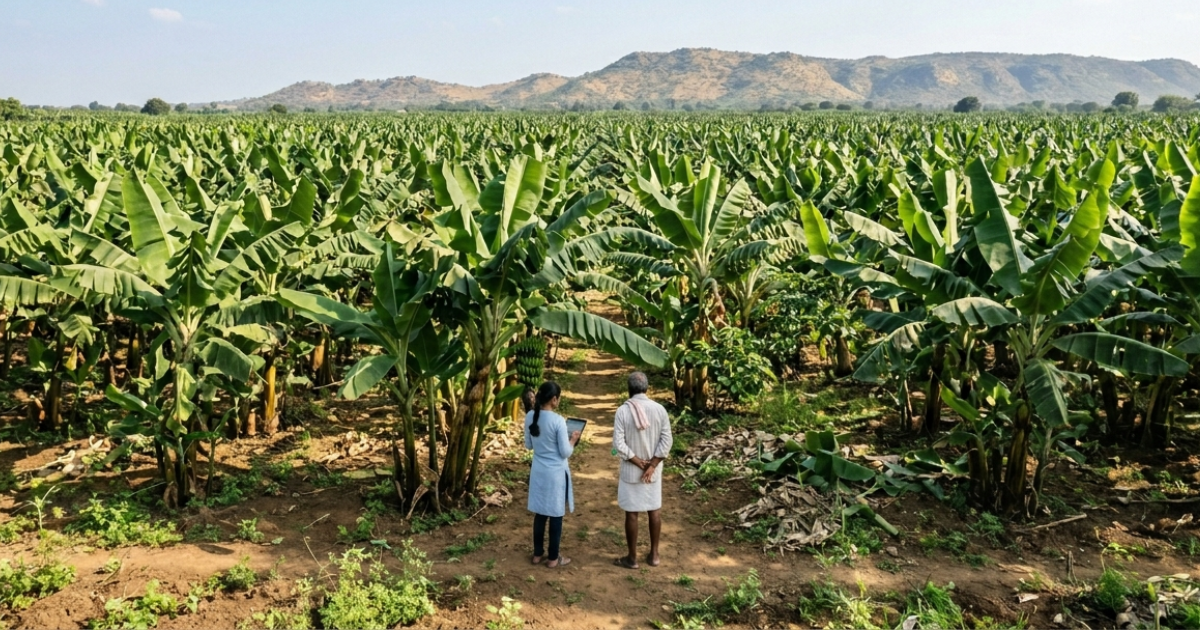
Note: The banner image is AI-generated and used for representational purposes.
.png)